
Your Privacy Choices

OUR SCIENCE
Where tradition becomes method.
Zenbotanique translates Chinese botanical practice into formulas built on two things: how a plant has been prepared for centuries, and how it behaves today. We do not shortcut either one.
METHOD BY PLANT → CORE PRINCIPLES
Three extraction pathways, each chosen for a reason.
A plant is not processed by one universal method. We choose temperature, pressure, and medium according to the raw material's structure, its constituent profile, and the intended formula format.

COLD-PROCESS EXTRACTION
Pressure expresses oil from the plant material without deliberately raising the process temperature.
YIELDSCold-pressed oils, botanical infusion oils, and oil-phase extracts that stay close to the original material.
TRADE-OFFOil yield may be lower than with pressurized extraction, and the result depends closely on the raw material.
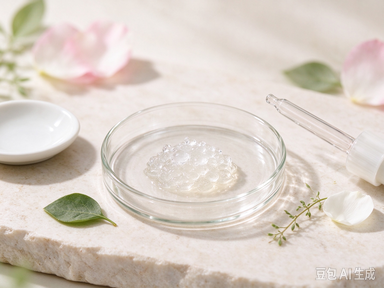
SUPERCRITICAL CO2 EXTRACTION
Above its critical point, CO2 combines gas-like diffusivity with liquid-like solvating power. It moves through the plant matrix and dissolves predominantly non-polar constituents.
YIELDSLow-residue extracts with tunable selectivity and control over volatile fractions.
TRADE-OFFHigh-pressure equipment and tighter process control are required, with higher production costs than mechanical pressing.
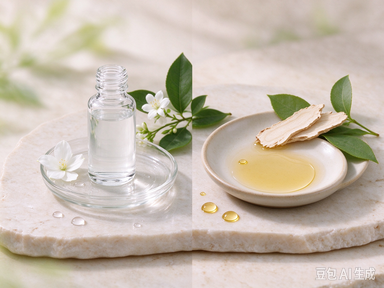
AQUEOUS / OIL-PHASE EXTRACTION
Water-soluble constituents move into the aqueous phase, while lipid-soluble constituents move into the oil phase. The medium shapes how the plant is expressed in the final formula.
YIELDSThe same plant can be developed in two carrier formats—water-based and oil-based—according to its chemistry and intended formula.
TRADE-OFFEach carrier format requires its own processing path and stability work.
THE TEA CRAFT
A quiet process, kept slow.
Seven steps, each done by hand and in small batches — the way it has been done for generations.

01 · PLUCKED BY HAND
Fresh leaves are picked each spring — one bud with one or two leaves — and every lot is dated before it enters the workroom. Chinese processing guidance for high-grade spring green tea specifies exactly this raw-material standard.

02 · WITHERED SLOWLY
Leaves are spread by hand in a cool, ventilated layer so moisture leaves evenly. Official guidance keeps the bed shallow — no deeper than 12 in (30 cm) — for roughly 3–10 hours; black-tea manufacture can run 14–18 hours.

03 · SET WITHIN HOURS
Heat is applied the same day to lock in color and stop oxidation. One reference green-tea process sets leaves at about 60% moisture against a pan at around 390°F (200°C); ISO defines the step as heating that inactivates polyphenol oxidase and peroxidase.

04 · SHAPED BY HAND
Still warm, the leaves are rolled to shape and release the juices behind the cup's depth. Regional guidance gives 10–20 minutes for green tea; a FAO/WHO record of Japanese green-tea manufacture begins with 30 minutes at 194°F (90°C).

05 · LEFT TO REST
Green tea moves straight from shaping to drying; it is not left to oxidize. Black tea differs — it rests to aerate, with one documented example (Kenya, FAO/WHO) using a 90-minute stage.

06 · DRIED IN SMALL BATCHES
Drying stabilizes the finished leaf. Chinese guidance sets green-tea moisture at no more than 7%; one reference process uses 210–265°F (100–130°C) for about 15 minutes, while a FAO/WHO Japanese example uses hot air at 175–195°F (80–90°C) for 20–25 minutes.

07 · REFINED, READY FOR THE CUP
A final pass checks uniformity, foreign material, and lot consistency before release. Where verification is needed, international methods apply — ISO 10727 (HPLC for caffeine) and ISO 20715 (catechin, caffeine, and theanine markers for tea classification).
Process ranges are reference points, not a universal recipe. Figures draw on published tea-processing references, including FAO/WHO tea-manufacture records and provincial Chinese green-tea guidance; tea-type definitions follow ISO 20715; analytical methods follow ISO 10727.
WHERE WE WORK
Named regions, dated batches.
Our botanicals are sourced from named regions in China — hibiscus from Anhui, matcha and tea from established growing regions, sandalwood from southern woodlands. We buy in small quantities, date every batch, and name every plant we use.

WHAT WE DO NOT CLAIM
We describe how a plant is prepared and how it behaves in a formula. We do not claim to diagnose, treat, cure, or prevent any disease. Our botanical library is written to be read, not to sell.
These statements have not been evaluated by the FDA. This product is not intended to diagnose, treat, cure, or prevent any disease.